


UV disinfection
Difference between ozone and UV
Ozone disinfect via air/ozone injected into water
UV Disinfect by exposing water to UV light
How does UV work
UV means ultraviolet
UV wave has high energy in its envelop
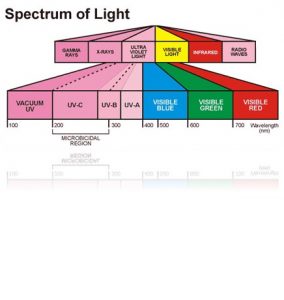
UV waves has various wave length, hence different applications
UV for disinfection has specific wave length of 254 angstrom
UV 254 wave length
This typical wavelength and high energy allows the wave to penetrate the DNA of bacteria and disable it
Disinfection mechanism
UV-C rays will destroy a minimum of 99.99% of harmful microorganisms, including E. coli, Cryptosporidium and Giardia.
Unlike chemical disinfection the organisms are unable to develop any immune mechanism against UV light.
The degree of UV inactivation of pathogens is directly proportional to the UV dose applied to the water
UV Intensity
UV dose is the product of UV light intensity and exposure time and is expressed in mJ/cm2.
NSF International has established a UV dose of 40 mJ/cm2 as the minimum UV dose required to ensure that all bacteria, viruses, Giardia and Cryptosporidium are killed or inactivated to a safe level.
Other standard allows 30mj/cm2. As per WHO
The Advantages of UV Disinfection
More effective against viruses than chlorine
Environmentally and user friendly, no dangerous chemicals to handle or store, no risks of overdosing
Low initial capital cost as well as reduced operating expenses when compared with similar technologies such as ozone, chlorine, etc.
Immediate treatment process, no need for holding tanks, long retention times, etc.
Extremely economical, hundreds of gallons may be treated for each penny of operating cost
No chemicals added to the water supply – no byproducts, (i.e. chlorine + organic compounds = trihalomethanes)
No change in taste, odor, pH, conductivity, nor the general chemistry of the water
Automatic operation without special attention or measurement, operator friendly
Simplicity and ease of maintenance, periodic cleaning, (if applicable), and annual lamp replacement, no moving parts to wear out
No handling of toxic chemicals, no need for specialized storage requirements
Easy installation, only two water connections and a power connection
Compatible with all other water purification processes, (i.e. reverse osmosis, filtration, water conditioning and softening)
Pre treatment before UV
To maximize the efficiency of the UV unit, pre-treatment is advisable. The most common pre-treatment methods are:
Sediment filters to remove silt that shelters microbes and scatters or absorbs the UV. Silt can drastically cut the effectiveness of a UV unit.
Carbon filtration to remove organic materials that absorb UV.
A water softening unit to remove minerals that coat the UV lamp sleeve and cut down transmitted light.
What affects UV performance
The effectiveness of a UV system in eliminating microbiological contamination is directly dependent on the physical qualities and/or clarity of your water supply.
Suspended Solids,Particulate matter can cause shielding problems, in which a microbe may pass through the UV chamber without actually having any direct UV penetration.
Iron/Manganese ,Will cause staining on the quartz sleeve that houses the UV bulb, at levels as low as 0.3 PPM of iron and 0.05 PPM of manganese. In this case, we recommend the installation of a Water Softener and/or an automatic Iron Filter system, as a proper step towards pretreatment which will help eliminate this staining problem. Note: not all UV systems will require the use of a softener if there is iron or manganese present, contact us for details.
More factors
Calcium/Magnesium, Hardness in your water will cause possible scale formation on the lamp protecting the quartz sleeve. Scaling problems will be especially magnified during low flow or no flow times when the calcium and magnesium ions tie up with carbonates and sulfates to form hard scale buildup inside the chamber and quartz sleeve.
Temperature is a determining factor, The optimal operating temperature of the UV lamp must be near 40 degrees C.UV levels will fluctuate with excessively high or low temperature levels.
Critical Parameters for performance
Flow rate
How does flow rate affects UV efficiency
Contact time
Optimum UV intensity
Doping of heavy metals